
Rebuilding Marriages with Emotion-Focused Marriage Therapy for Couples
When your marriage feels strained, it doesn’t stay neatly contained inside one conversation. It shows up at dinner. In the car. In the silence before bed. You may look at your partner and wonder how the closeness you once felt became tension, distance, or constant misunderstanding. Many couples begin searching for a marriage counselor when they realize they are having the same fight over and over again. They don’t necessarily want to leave the marriage. They want relief. They want to feel connected again.
At Melodie Alexander Counseling, I work with couples throughout Plano, TX, who are longing for that sense of safety and closeness to return. Emotion-Focused Therapy (EFT) offers a clear, research-supported path for rebuilding emotional security. In this article, I’ll walk you through how this process works and what healing can look like for you.
Key Takeaways
Disconnection is often rooted in unmet attachment needs, not a lack of love.
Repeated conflict reflects a cycle you can change.
Emotional safety calms the nervous system and improves communication.
EFT provides a structured, compassionate framework for repair.
Even one willing partner can begin shifting the pattern.
When You Feel Stuck in the Same Argument
You may recognize the pattern immediately. One of you brings up a concern. The other feels criticized and withdraws. One partner pushes harder. The second partner shuts down further. Eventually, you both feel unheard and alone.
Over time, resentment builds quietly. You may begin to feel more like roommates than romantic partners. Small misunderstandings carry outsized emotional weight.
The Emotional Questions Beneath the Conflict
Most couples are not arguing about dishes, schedules, or tone of voice. Beneath those surface topics are deeper questions:
Do I matter to you?
Will you be there when I need you?
Am I safe with you emotionally?
Attachment science explains why these questions feel so intense. Humans are wired for connection. When that connection feels threatened, the nervous system reacts quickly. Some people protest with anger or urgency. Others protect themselves by shutting down.
As a marriage therapist, I help couples slow this cycle down. Instead of focusing on who is right or wrong, we look at the pattern between you. When you see the cycle clearly, blame often softens. You begin to recognize that the problem is the interaction pattern, not your partner’s character.
Understanding Attachment: The Core of EFT
Emotionally Focused Therapy is built on attachment theory. Attachment is not a weakness. It is a fundamental human need.
When you feel securely connected to your partner, your nervous system settles. You think more clearly. You are less reactive. You are more open to compromise.
Clinical research consistently supports EFT as an effective approach for couples. Studies show that approximately 70-75% of couples move from distress to recovery through this model, and many maintain those gains over time. That statistic reflects meaningful, lasting change.
Through marriage counseling in Plano, the goal is not simply to reduce arguments. The goal is to create secure emotional bonding so that conflict feels manageable rather than threatening.
How Insecurity Shows Up in Marriage
Emotional insecurity can show up in subtle ways. You might feel overly sensitive to small shifts in tone. You may assume the worst when your partner seems distracted. Or you may tell yourself you shouldn’t need reassurance, even though part of you longs for it.
In sessions at Melodie Alexander Counseling, we gently explore how these reactions make sense in the context of your history and current stressors. Rather than labeling one partner as “too emotional” or the other as “distant,” we look at how each of you protects yourself when you feel vulnerable.
That shift alone often brings relief.
The Three Stages of the Healing Process
Emotion-Focused Therapy is structured and intentional. You are not left to “just talk it out.” There is a clear roadmap.
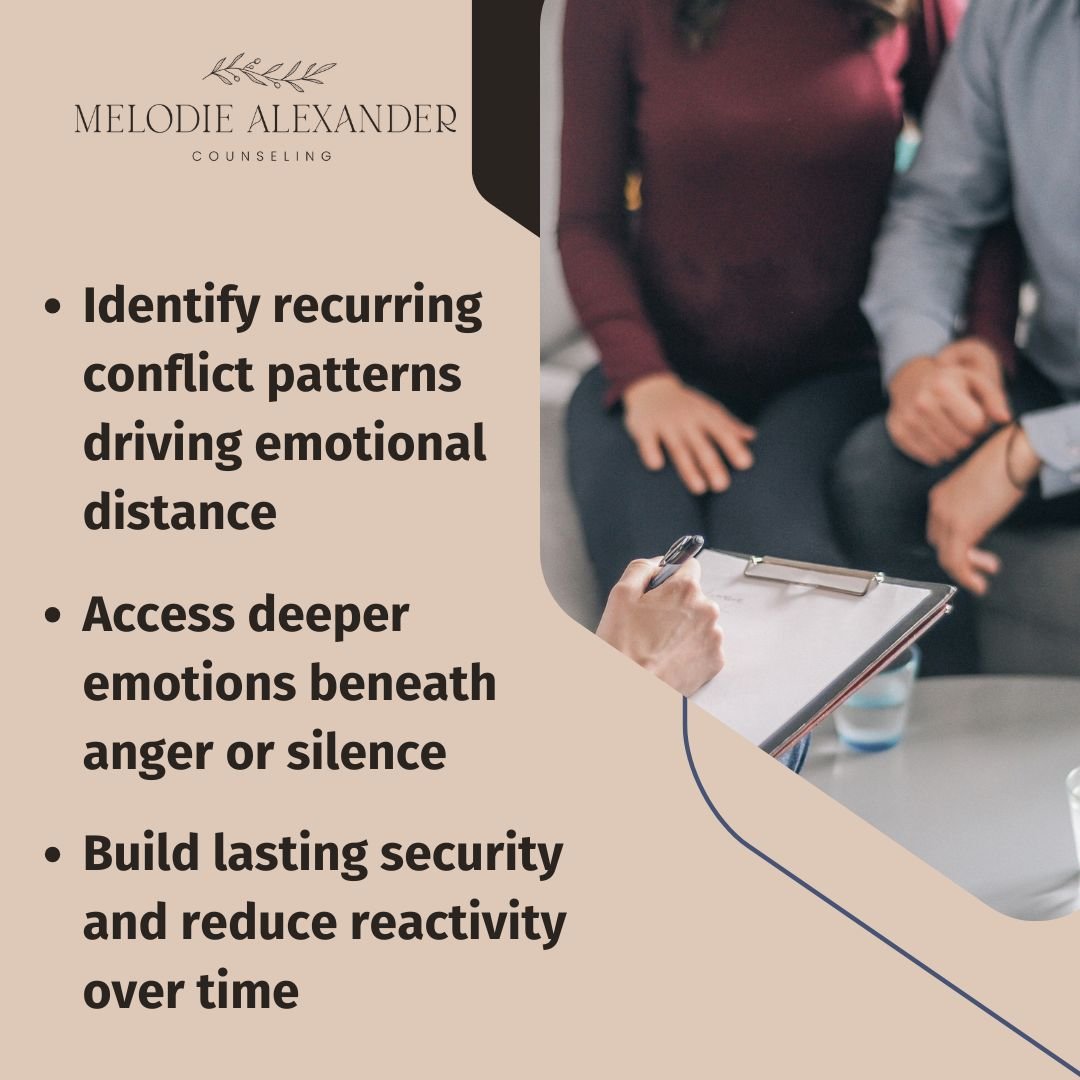
Stage One: Identifying the Negative Cycle
In the initial stage, we map your recurring pattern. Who pursues connection? Who withdraws? What triggers escalation?
Many couples feel immediate clarity in this phase. When you see how the cycle unfolds, you begin to understand that both of you are reacting to fear of disconnection. You are not enemies. You are partners caught in a loop.
Stage Two: Accessing Primary Emotions
Anger, defensiveness, and silence are often secondary emotions. Beneath them are softer, more vulnerable feelings such as fear, sadness, or longing.
In this stage, I guide each partner in safely expressing those primary emotions. This can feel unfamiliar initially. It may feel risky. But when vulnerability is met with responsiveness rather than criticism, something shifts.
You begin to feel seen.
Stage Three: Creating New Patterns of Connection
As emotional safety grows, new interactions emerge. You learn to express your needs in ways that invite connection rather than trigger defensiveness.
Over time, many couples describe their marriage as evolving into a safe haven. They feel more supported during stress. They experience greater comfort and understanding. The same conversations that once escalated now feel manageable.
Integrating Trauma-Informed Care
Not all relational patterns begin inside the marriage itself.
Early life experiences shape how you respond to closeness and conflict. If you learned that emotional needs were dismissed or unsafe, your nervous system may react strongly when you sense distance now.
My training includes advanced work in EFT, EMDR, and Internal Family Systems. I practice from a trauma-informed perspective, meaning we approach your history with care and respect.
Exploring Attachment History
After the introductory joint session, I meet individually with each partner. During these sessions, we explore attachment history and coping patterns formed earlier in life. This is not about blaming your past. It is about understanding how you learned to protect yourself.
When these patterns are brought into awareness, you gain choice. You are no longer reacting automatically. You are responding intentionally.
Effective marriage counseling services must consider both present dynamics and underlying attachment wounds. When both layers are addressed, healing becomes more stable and sustainable.
What to Expect in the First Sessions
Starting therapy can feel intimidating. At Melodie Alexander Counseling, I prioritize helping you feel comfortable and at ease from the beginning.
In the initial session, we explore your specific relational concerns and what you hope to accomplish. If you have worked with a previous therapist, we can discuss what was helpful and what was not.
After the individual sessions, we return to working together as a couple. From there, we begin identifying your cycle and gradually move into deeper emotional work.
The Role of Consistency
Therapy works best when it is consistent. I typically recommend weekly sessions in the beginning. This frequency helps build momentum and emotional safety. As you experience progress, we can discuss spacing sessions further apart.
Each session is 50 minutes long. Appointments are available Monday through Friday. I offer both in-person and secure online counseling for couples.
When Only One Partner Is Ready
You may be reading this while your spouse remains unsure about therapy.
It is common for one partner to hesitate. If that is your situation, you can still begin individually. Working on your part of the negative cycle can create meaningful shifts at home.
When one partner becomes less reactive, the dynamic often softens. You may find yourself pausing instead of escalating. You may respond with curiosity instead of defensiveness.
At Melodie Alexander Counseling, I offer a complimentary 15-minute consultation to help you determine whether this approach feels like a good fit. Sometimes just having that conversation reduces anxiety about taking the next step.
Practical Details That Support the Process
Clear expectations help you feel more grounded. Online sessions are available through a secure, HIPAA-compliant platform for those who prefer virtual appointments.
I am considered an out-of-network provider and can provide a Superbill for possible reimbursement. Many couples choose private pay to maintain confidentiality and avoid diagnostic labels attached to insurance records.
These logistical details matter. When you know what to expect, you can focus your energy on the emotional work rather than administrative concerns.
Rebuilding Safety, One Conversation at a Time
In Plano, TX, I often meet couples who feel discouraged. They tell me they have tried everything. They worry that if they haven’t figured it out by now, maybe it is too late. It is not too late.
Healing rarely happens through one dramatic conversation. It happens through many small moments of emotional risk met with care. It happens when you slow down enough to say, “I’m scared of losing you,” instead of, “You never show up.”
At Melodie Alexander Counseling, the work is collaborative. We move at a pace that feels steady and respectful. You are not judged. You are supported.
If you are considering reaching out to a marriage counselor in Plano, TX, I invite you to take that first step. Your marriage can become a place of safety again. With guidance, structure, and willingness, reconnection is possible. To learn more, contact (469) 232-7877 or hello@melodiealexandercounseling.com.